
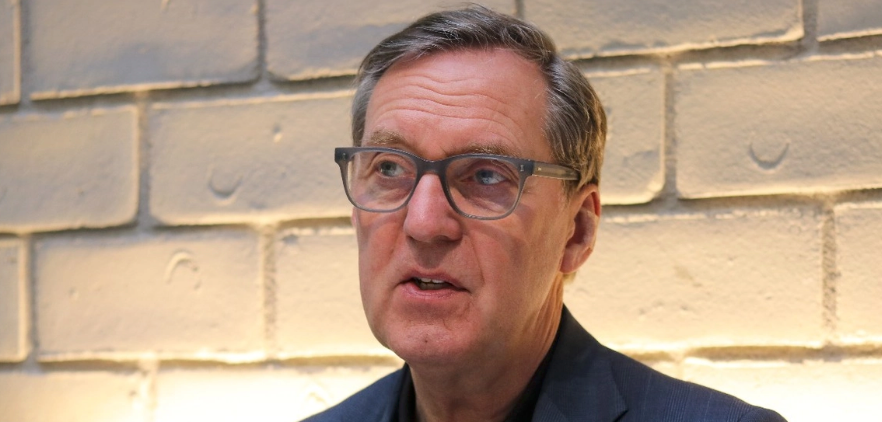
Alan Milburn, former British Health Minister: “The Spanish healthcare system is a success story, but, like all European systems, it must change.”
On April 20, 2026, journalist Nuria Cordón, from Medicina Responsable (Responsible Medicine), published the following interview with Alan Milburn, former UK Health Minister and current health advisor to the British government, who collaborated on the development of the “10-Year Health Plan for England.”
An exceptional interview (both the questions and the answers), well worth reading.
European healthcare systems are at a turning point. The aging population, the rise in chronic diseases, and the impact of the technological revolution are forcing a rethinking of models designed more than half a century ago. For Alan Milburn, former UK Health Minister and one of the most influential voices in the debate on reforming public health systems, change is no longer a matter of choice, but a necessity.
Milburn, who led the British healthcare system between 1999 and 2003 and is involved in designing England’s ten-year healthcare plan, views the Spanish case with a mixture of recognition and caution. In his opinion, our healthcare system has “extraordinary professionals and a high level of innovation,” but it shares the same structural challenges with the rest of Europe: growing demand, increasingly strained resources, and a model that needs to adapt to the new reality of chronic diseases.
In this interview with Responsible Medicine, Milburn reflects on the future of European healthcare systems and the reforms that, in his view, will be inevitable in the coming years.
Last year, England presented a ten-year healthcare plan, in which you are involved. Why was it necessary?
The National Health Service (NHS) in England has many positive aspects, but it is an older system facing a new problem: chronic diseases, such as diabetes and obesity, which now account for around 70% of the system’s costs. In fact, approximately 25% of patients in the UK have a long-term illness. The system was designed 70 or 80 years ago to treat people who became ill and then recovered. Now, people don’t recover; they live with their illness, and that requires a very different system.
The system is under pressure for several reasons. Costs are rising, and demand is growing and changing. Furthermore, technology is transforming everything. Advances in genetics, data analysis, and artificial intelligence are enabling a shift from a system focused on diagnosing and treating to one capable of anticipating disease. That, too, demands a different system.
One of the most important changes in the plan is the shift from hospital to community care. What does this mean?
It means that today in England, one in four people occupying a hospital bed shouldn’t be there. Obviously, if there’s an emergency or an accident, the hospital is the right place. If a child is ill and needs urgent care, of course they should go to the hospital. But many people go to the emergency department because it’s the only service available 24 hours a day. We need to ensure that those who are in the hospital truly need it. Many patients can be cared for in the community or in their own homes. It’s better for them, more comfortable, and more efficient.
Furthermore, access to healthcare will increasingly be digital, via mobile phones. In England, we have the NHS app, which is used by around 40 million adults, representing about three out of every four. It allows access to medical records, appointment booking, and information about illnesses. In the future, it will also allow virtual consultations with doctors and nurses. So, when we talk about moving from the hospital to the community, we’re also talking about more digital access. It’s how people already manage many other aspects of their lives, so healthcare is simply catching up.
Do you think a ten-year strategic plan like the NHS’s would be possible in Spain, where political cycles tend to be shorter and healthcare is decentralized?
Every country is different, but the National Health Service in England and the healthcare system in Spain are very similar in many respects. They have a similar origin, a similar history, and, in some cases, a comparable structure. There are always lessons to be learned. There are also lessons the UK can learn from the Spanish healthcare system. But the big issue is that across Europe, healthcare is under pressure; healthcare systems are facing increasing strain, and governments are facing enormous fiscal pressures.
These pressures are being further amplified by the current geopolitical situation: we’re going to have to spend more on defense and military spending, and that’s going to put even more pressure on healthcare budgets. That means we’re going to have to be much more efficient and much more productive. We have to make sure we get more value for the money we spend and better results than we’re achieving now. That’s why some of the reforms being implemented in the UK could be relevant for Spain.
In fact, you’ve pointed out on previous occasions that the problem in healthcare isn’t just how much money is invested, but how it’s used.
Exactly. In healthcare, we tend to focus a lot on what we put into the system, in terms of money and resources, but much less on what we get out of the system. We need to focus more on the value we’re getting and the results we’re achieving: whether people are getting better and whether treatments are effective. We know some treatments work, and we know others don’t. So it’s not a question of the volume of money. The critical issue is how that money is used.
For example, in England, we measure NHS productivity every year. On average, it’s been growing at around 0.6% annually, which is very low. That’s why we’ve set new targets to increase productivity by up to 2% annually. Last year it increased by 2.8%, which shows we can get much more out of the resources we’re already investing, but it requires a lot of focus and many changes.
But policy change can generate conflicts that politicians are sometimes unwilling to address, especially if they don’t think beyond their immediate mandate.
It’s not an easy job to be a political leader in healthcare. The demands are always greater than what can be offered. But it’s wise to think about long-term changes, because change truly takes time. We must be honest with citizens and voters about what is possible and when it will be possible.
Most people understand that major changes take time. And it’s important for politicians to be transparent with the public about this. That’s precisely why we’ve created a ten-year plan in England, because we recognize that the changes needed are fundamental and that they will take time.
If you had to give the Spanish government one piece of advice on healthcare policy, what would it be?
The best advice would be that the status quo is not an option. The challenges facing healthcare and the opportunities ahead require a different way of thinking. We have to ask ourselves how we are going to organize the system to make it sustainable. Not only financially, but also socially, with the support of the population. The most important thing is to have a clear roadmap. To understand where healthcare is headed.
Technology is driving much of this change. Genetics and data analysis are unstoppable and positive advances. In England, for example, we are introducing genetic testing at birth so that every child has a genetic analysis. This allows us to identify which diseases they may be at risk for and act earlier. It’s about looking to the future, imagining what the healthcare system will be like, and working backward from that future. My advice to any health minister is always the same: allow extra time, because changes always take twice as long as you think.
Spain has one of the most highly regarded healthcare systems in Europe, but it also faces significant pressures. What do you think is its main structural weakness?
The Spanish healthcare system has enormous strengths. It has extraordinary professionals, a high level of innovation, and the health of the population has improved tremendously in recent decades. It’s a success story. But, like all European healthcare systems, it is facing changes in demand and the impact of technology. Not changing is not an option. It must. The question is how to make those changes in a way that is politically acceptable to the public. And that requires a very honest conversation with citizens about what is possible and why the changes are being made. It also requires a great deal of political courage to push through those reforms.
Spain, like England, is in the midst of a doctors’ strike. What similarities do you see with the Spanish situation?
I don’t know if they’re related. In England, it’s been the trainee doctors, the residents, who have been on strike. They’ve had significant pay raises and are now demanding even bigger ones. That’s not possible, nor would it be fair, because other healthcare professionals aren’t receiving those raises either. But it’s part of a broader debate about whether we can keep spending more and more money indefinitely. And the reality is, we can’t.
Doctors are fundamental to the future of the healthcare system. They are the driving force of the system and enjoy enormous trust from patients. That’s why it’s important for doctors to feel like they are part of the system, and not simply have the system impose decisions on them. That means giving them more power and more influence within the system, especially at the local level, where they interact directly with patients.
How do you think technology will change the work of doctors?
Technology will significantly change the nature of medical work. For example, the NHS app has already prevented around 2.5 million appointments with family doctors because patients have been able to address their needs digitally.
The role of the doctor is changing significantly. In the future, we might even need fewer doctors than we currently think because technology will be able to meet some of the healthcare needs. Technology will then be a very important part of the solution, as it is in many other areas of life.
Is there a risk that technology will increase inequalities in access to healthcare?
There are significant inequalities in society and also in healthcare. Everything we do must be aimed at reducing these inequalities. That is why it is important that advances in genetics and artificial intelligence are available to all citizens, regardless of their background or circumstances.
During the Forbes Healthcare Summit, you stated that “the healthcare of the future will be predictive, or it will not exist.” What does predictive healthcare really mean, and what structural changes does it require in current healthcare systems? In the future, we will be better able to predict who will get sick, why they will get sick, and what we can do to prevent it. For a long time, health policymakers have wanted a true health system, not just a disease system. Technology gives us the opportunity to do this for the first time. But to seize this opportunity, we must change the nature of healthcare systems. We need a different mindset, new infrastructure, new organizational models, and new ways of measuring performance.
The fundamental principles, such as providing healthcare based on need, not ability to pay, must be maintained. That shouldn’t change. What must change is how we apply those principles.
How do you see European healthcare systems in 20 years?
If the necessary reforms are implemented, they will be sustainable, technology-driven, much more personalized, and much more focused on prevention. But that depends on policymakers taking the lead in driving change. In the world, there are two options: resist change or lead it. And in healthcare, there is only one place to be: leading change.


